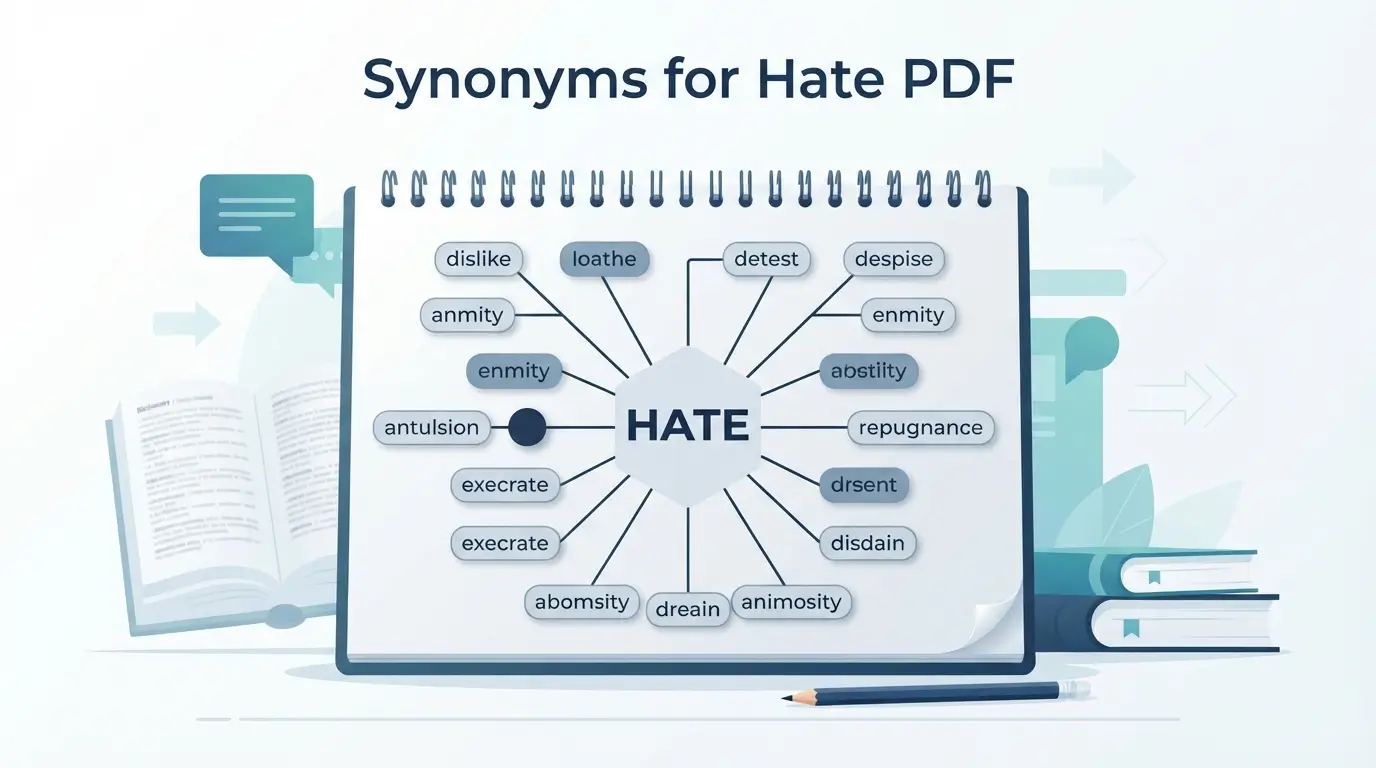
Synonyms for hate PDF is a downloadable list of words that have a similar meaning to hate. A synonyms for hate PDF helps you learn stronger, softer, and more accurate words instead of repeating the same word again and again. If you are searching for a synonyms for hate PDF, you probably want an easy reference that you can read, print, or save for school, writing, or daily English practice.
Imagine writing an essay, a blog post, or even a simple email. You use the word hate several times, and suddenly your writing sounds repetitive. A richer vocabulary can make every sentence clearer and more interesting. That is why many students, bloggers, teachers, and English learners look for a synonyms for hate PDF that they can keep on their phone or print for later.
A simple example is this: instead of saying, “I hate waking up early,” you might say, “I dislike waking up early,” or “I dread waking up early.” Each word gives a slightly different feeling while keeping your writing natural.
Learning these words helps students improve essays, bloggers create engaging articles, content writers avoid repetition, and daily English users express feelings more clearly. This guide explains each word in simple English, gives real-life examples, and provides an organized list that is easy to understand.
“The difference between the right word and the almost right word is the difference between lightning and a lightning bug.” — Mark Twain
“Words are the tools of thought.” — Samuel Johnson
What is the strongest word for hate?
Some words express a stronger feeling than hate. They show deep anger, disgust, or complete rejection. The best choice depends on the situation and the emotion you want to express.
For example, loathe is often considered stronger than hate. It suggests intense dislike that lasts for a long time. Words like despise, detest, and abhor also express powerful negative feelings.
If you are writing a story or essay, choosing the right word makes your message more accurate instead of simply repeating hate.
Strong words related to hate
- Loathe shows very deep dislike.
- Abhor expresses moral disgust.
- Despise means looking down on someone with strong dislike.
Synonyms for hate PDF in English
A synonyms for hate PDF in English is a printable vocabulary resource that lists words similar to hate with simple meanings and examples. Many English learners use these PDFs because they are easy to review before exams or writing assignments.
A PDF version also lets you study offline. Teachers often print vocabulary sheets so students can practice new words during lessons or homework.
Whether you are learning English or improving your writing, a well-organized PDF makes vocabulary practice faster and easier.
Benefits of a PDF vocabulary list
- Easy to print and study anywhere.
- Helpful for school, college, and self-study.
- Great for quick revision before writing.
Synonyms for hate or dislike
Although people sometimes use hate and dislike in the same way, they are not equal. Dislike is much softer, while hate shows a stronger emotional response.
For example, saying “I dislike broccoli” sounds polite. Saying “I hate broccoli” sounds much stronger. Choosing the correct word helps your communication sound more natural.
English offers many words between these two extremes, allowing you to express your feelings with greater accuracy.
Common alternatives
- Dislike expresses a mild negative feeling.
- Detest shows a very strong dislike.
- Loathe expresses intense emotional dislike.
Another word for hate that starts with R
Many readers search for another word for hate beginning with the letter R. While there is no perfect one-word replacement that starts with R, several related words may fit certain situations.
Words such as reject, resent, repel, and repudiate describe negative feelings or actions, although each has its own meaning.
Always choose a word based on the sentence rather than only the first letter.
Useful words beginning with R
- Resent means feeling bitterness because of unfair treatment.
- Reject means refusing to accept something.
- Repudiate means formally refusing or denying something.
Synonyms for hate as a verb
When hate is used as a verb, it describes feeling strong dislike toward a person, object, activity, or idea. Many verbs can replace it depending on how strong the emotion is.
For example, dislike is softer, while abhor is much stronger. Selecting the right verb makes your writing more precise.
Writers often replace repeated verbs to improve readability and keep readers interested.
“The limits of my language mean the limits of my world.” — Ludwig Wittgenstein
Verb alternatives
- Dislike for mild dislike.
- Detest for strong dislike.
- Abhor for deep moral dislike.
Hate synonyms and antonyms
Learning both synonyms and antonyms helps you understand vocabulary better. Synonyms have similar meanings, while antonyms have opposite meanings.
For hate, common synonyms include loathe, despise, detest, and abhor. Common antonyms include love, admire, cherish, and appreciate.
Studying both groups makes your speaking and writing more balanced and expressive.
Examples
- Synonyms help avoid repeating the same word.
- Antonyms show opposite meanings clearly.
- Both improve writing and speaking skills.
Hate words list
A hate words list is simply a collection of vocabulary that expresses different levels of dislike or negative feelings. It does not refer to offensive or abusive language. Instead, it focuses on ordinary English vocabulary used in books, conversations, and writing.
Some words express mild dislike, while others show intense emotional or moral rejection.
Learning these words helps you choose the right expression instead of using hate repeatedly.
What a vocabulary list includes
- Mild words like dislike.
- Medium-strength words like resent.
- Strong words like loathe and abhor.
Another word for hate speech
The term hate speech is a specific legal and social expression. There is usually no exact synonym that replaces it in every context. Instead, writers use related phrases depending on the discussion.
Examples include abusive speech, hostile language, discriminatory speech, bigoted language, or prejudicial speech. These expressions describe related ideas, but they may not always carry the same legal meaning.
When writing formally, it is usually best to use the original term hate speech if that is the exact concept you mean.
Related expressions
- Hostile language describes aggressive communication.
- Discriminatory speech focuses on unfair treatment.
- Abusive speech refers to insulting or harmful language.
Comparison Table of Related Keywords
| Keyword | Meaning | Usage Type | Common Context |
| What is the strongest word for hate | Looks for the most intense synonym | Educational | Vocabulary learning, writing |
| Synonyms for hate PDF in English | Printable list of hate synonyms | Educational | Schools, self-study, exams |
| Synonyms for hate or dislike | Compares hate with milder alternatives | Everyday English | Conversation, essays |
| Another word for hate that starts with R | Searches for vocabulary beginning with R | Educational | Word games, writing |
| Synonyms for hate as a verb | Verb replacements for hate | Grammar | Essays, speaking |
| Hate synonyms and antonyms | Similar and opposite words | Educational | Vocabulary practice |
| Hate words list | Collection of words expressing dislike | Vocabulary | Learning English |
| Another word for hate speech | Related expressions for the phrase hate speech | Formal/Professional | News, law, social discussions |
1. Dislike
Meaning:
Dislike means not liking someone or something, but it is much weaker than hate.
Examples:
- I dislike very spicy food.
- She dislikes getting up early.
2. Loathe
Meaning:
Loathe means to feel extremely strong dislike for someone or something.
Examples:
- I loathe wasting food.
- They loathe dishonest behavior.
3. Detest
Meaning:
Detest means to dislike something very strongly.
Examples:
- She detests rude manners.
- We detest unfair rules.
4. Despise
Meaning:
Despise means to strongly dislike someone because you think they are bad or wrong.
Examples:
- He despises cheating.
- They despise cruelty to animals.
5. Abhor
Meaning:
Abhor means to feel deep disgust or strong hate toward something.
Examples:
- Many people abhor violence.
- She abhors lying.
6. Resent
Meaning:
Resent means to feel angry because something seems unfair.
Examples:
- I resent being ignored.
- He resents unfair criticism.
7. Reject
Meaning:
Reject means to refuse to accept someone or something.
Examples:
- They rejected the offer.
- She rejects false information.
8. Dread
Meaning:
Dread means to fear or strongly dislike something that is coming.
Examples:
- I dread Monday mornings.
- She dreads long meetings.
9. Scorn
Meaning:
Scorn means to treat someone or something with disrespect.
Examples:
- He scorned the unfair idea.
- They scorn dishonest people.
10. Disdain
Meaning:
Disdain means to think someone or something is not worthy of respect.
Examples:
- She looked at the rumor with disdain.
- He spoke with disdain about cheating.
11. Revile
Meaning:
Revile means to speak about someone in a very insulting way.
Examples:
- They reviled the dishonest leader.
- He refused to revile anyone online.
12. Revulsion
Meaning:
Revulsion means a strong feeling of disgust.
Examples:
- She felt revulsion after seeing the mess.
- His actions caused public revulsion.
13. Repulsion
Meaning:
Repulsion means a powerful feeling of dislike or disgust.
Examples:
- I felt repulsion toward the smell.
- Many people showed repulsion at the cruelty.
14. Disgust
Meaning:
Disgust means a strong feeling that something is unpleasant or offensive.
Examples:
- The dirty room filled her with disgust.
- He showed disgust after hearing the news.
15. Contempt
Meaning:
Contempt means believing someone deserves no respect.
Examples:
- She looked at the bully with contempt.
- His words were full of contempt.
16. Antagonize
Meaning:
Antagonize means to make someone angry or hostile.
Examples:
- Don’t antagonize your teammates.
- His comments antagonized the crowd.
17. Offend
Meaning:
Offend means to upset or hurt someone’s feelings.
Examples:
- I did not mean to offend you.
- Her joke offended several people.
18. Irritate
Meaning:
Irritate means to annoy someone a little.
Examples:
- Loud noises irritate me.
- His constant tapping irritates everyone.
19. Annoy
Meaning:
Annoy means to make someone slightly angry or bothered.
Examples:
- The buzzing fly annoys me.
- She was annoyed by the delay.
20. Displease
Meaning:
Displease means to make someone unhappy or dissatisfied.
Examples:
- The decision displeased the team.
- His behavior displeases his parents.
21. Oppose
Meaning:
Oppose means to disagree with or fight against something.
Examples:
- Many people oppose pollution.
- She opposed the new rule.
22. Object
Meaning:
Object means to express disagreement with something.
Examples:
- I object to unfair treatment.
- They objected to the proposal.
23. Condemn
Meaning:
Condemn means to strongly say that something is wrong.
Examples:
- Leaders condemned the attack.
- We should condemn bullying.
24. Denounce
Meaning:
Denounce means to publicly criticize something.
Examples:
- The group denounced corruption.
- She denounced the false claims.
25. Recoil
Meaning:
Recoil means to move back because of fear or disgust.
Examples:
- He recoiled from the bad smell.
- She recoiled after touching the hot pan.
26. Shun
Meaning:
Shun means to deliberately avoid someone or something.
Examples:
- They shun dishonest people.
- He shunned unhealthy habits.
27. Avoid
Meaning:
Avoid means to stay away from someone or something.
Examples:
- I avoid heavy traffic.
- She avoids negative conversations.
28. Boycott
Meaning:
Boycott means to stop using or supporting something as a protest.
Examples:
- Many people boycotted the product.
- They plan to boycott the event.
29. Resist
Meaning:
Resist means to refuse to accept or give in to something.
Examples:
- She resisted the temptation.
- We should resist unfair pressure.
30. Protest
Meaning:
Protest means to show that you strongly disagree with something.
Examples:
- Students protested peacefully.
- They protested against the decision.
31. Spurn
Meaning:
Spurn means to reject someone or something with little respect.
Examples:
- He spurned the offer.
- She spurned unfair advice.
32. Spite
Meaning:
Spite means a desire to upset or hurt someone because of anger.
Examples:
- He acted out of spite.
- She ignored him out of spite.
33. Malice
Meaning:
Malice means the wish to cause harm to another person.
Examples:
- There was no malice in her words.
- The act was done with malice.
34. Hostility
Meaning:
Hostility means unfriendly or angry behavior toward others.
Examples:
- The meeting ended in hostility.
- They showed hostility toward the idea.
35. Animosity
Meaning:
Animosity means a strong feeling of anger or dislike toward someone.
Examples:
- There was animosity between the two teams.
- Years of arguments created animosity.
36. Bitterness
Meaning:
Bitterness means lasting anger or disappointment.
Examples:
- He spoke with bitterness after losing the job.
- The unfair decision left her with bitterness.
37. Enmity
Meaning:
Enmity means deep and lasting hatred between people or groups.
Examples:
- The families lived in enmity for years.
- Old enmity caused many problems.
38. Aversion
Meaning:
Aversion means a strong dislike for something.
Examples:
- She has an aversion to loud music.
- His aversion to seafood is well known.
39. Ill Will
Meaning:
Ill will means unfriendly or negative feelings toward someone.
Examples:
- There was no ill will after the discussion.
- They solved the problem without ill will.
40. Acrimony
Meaning:
Acrimony means angry and bitter feelings shown through words.
Examples:
- The debate ended with acrimony.
- Their conversation was full of acrimony.
41. Grudge
Meaning:
Grudge means lasting anger because of something that happened in the past.
Examples:
- He still holds a grudge against his former friend.
- Letting go of a grudge can bring peace.
42. Vengeance
Meaning:
Vengeance means the act of trying to punish someone for hurting you.
Examples:
- The story is about vengeance and forgiveness.
- He wanted vengeance after the betrayal.
43. Venom
Meaning:
Venom means extreme anger or hateful feelings expressed in words.
Examples:
- She spoke with venom during the argument.
- His message was filled with venom.
44. Rage
Meaning:
Rage means very intense anger.
Examples:
- His face showed rage after the mistake.
- She struggled to control her rage.
45. Fury
Meaning:
Fury means powerful and uncontrolled anger.
Examples:
- The news filled him with fury.
- She left the room in fury.
46. Wrath
Meaning:
Wrath means extreme anger, often used in formal or literary writing.
Examples:
- The king showed his wrath.
- The novel describes the hero’s wrath.
47. Loathing
Meaning:
Loathing means a deep feeling of hate or disgust.
Examples:
- She felt loathing toward cruelty.
- His loathing of dishonesty was clear.
48. Disfavor
Meaning:
Disfavor means a lack of approval or support.
Examples:
- The plan fell into disfavor.
- His ideas received public disfavor.
49. Repudiate
Meaning:
Repudiate means to formally reject or refuse to accept something.
Examples:
- The company repudiated the false claims.
- She repudiated the unfair accusation.
50. Abominate
Meaning:
Abominate means to hate something very strongly.
Examples:
- I abominate dishonesty.
- They abominate cruelty to animals.
Frequently Asked Questions (FAQs)
What is the best synonym for hate?
The best synonym depends on the situation. Dislike is suitable for mild feelings, while loathe, detest, despise, and abhor express much stronger emotions.
What is the strongest word for hate?
Many English speakers consider loathe and abhor among the strongest synonyms for hate because they express deep dislike or moral disgust.
Is dislike the same as hate?
No. Dislike is much weaker than hate. You can dislike a food or a movie, but hate expresses a much stronger emotion.
Can I download a synonyms for hate PDF?
Yes. Many vocabulary websites provide printable PDF lists. You can also create your own PDF from this guide for offline study and revision.
Why should I learn synonyms for hate?
Learning synonyms helps you:
- Write better essays and articles.
- Avoid repeating the same word.
- Improve your English vocabulary.
- Speak more naturally in everyday conversations.
Conclusion
Learning a synonyms for hate PDF is one of the easiest ways to expand your English vocabulary. Instead of repeating the word hate, you can choose words that match the exact feeling you want to express. Sometimes dislike is enough. In other situations, words like loathe, detest, despise, or abhor describe much stronger emotions. Picking the right word makes your writing and speaking clearer and more natural.
A strong vocabulary benefits everyone. Students can write better school assignments and exam answers. Bloggers can create more engaging articles without repeating the same words. Content writers can make their work more professional and SEO-friendly. Even in everyday conversations, using different words helps you communicate your thoughts with confidence.
Keep practicing these synonyms in emails, essays, presentations, social media posts, and daily conversations. Reading books, writing short paragraphs, and reviewing your vocabulary list regularly will help these words become part of your everyday English. Saving or printing a synonyms for hate PDF also gives you a quick reference whenever you need a better word.
Remember that every new word you learn adds another tool to your communication skills. Over time, your writing will sound more fluent, your speaking will become more expressive, and you’ll be able to share your ideas with greater accuracy.
“The more words you know, the more clearly you can express your thoughts.”
“A rich vocabulary is the key to confident communication.”
“Learning one new word every day builds a lifetime of better communication.”

Rev. Grace Thomas ek compassionate aur faith-driven writer hain jo healing, gratitude aur divine guidance par focus karti hain. Unka mission hai logon ko prayers ke zariye hope aur shifa dena. Grace apne likhe hue words se readers ko inspire karti hain ke woh apni roohani journey mein mazboot rahen.
👉 Read her prayers and reflections on Prayerifi