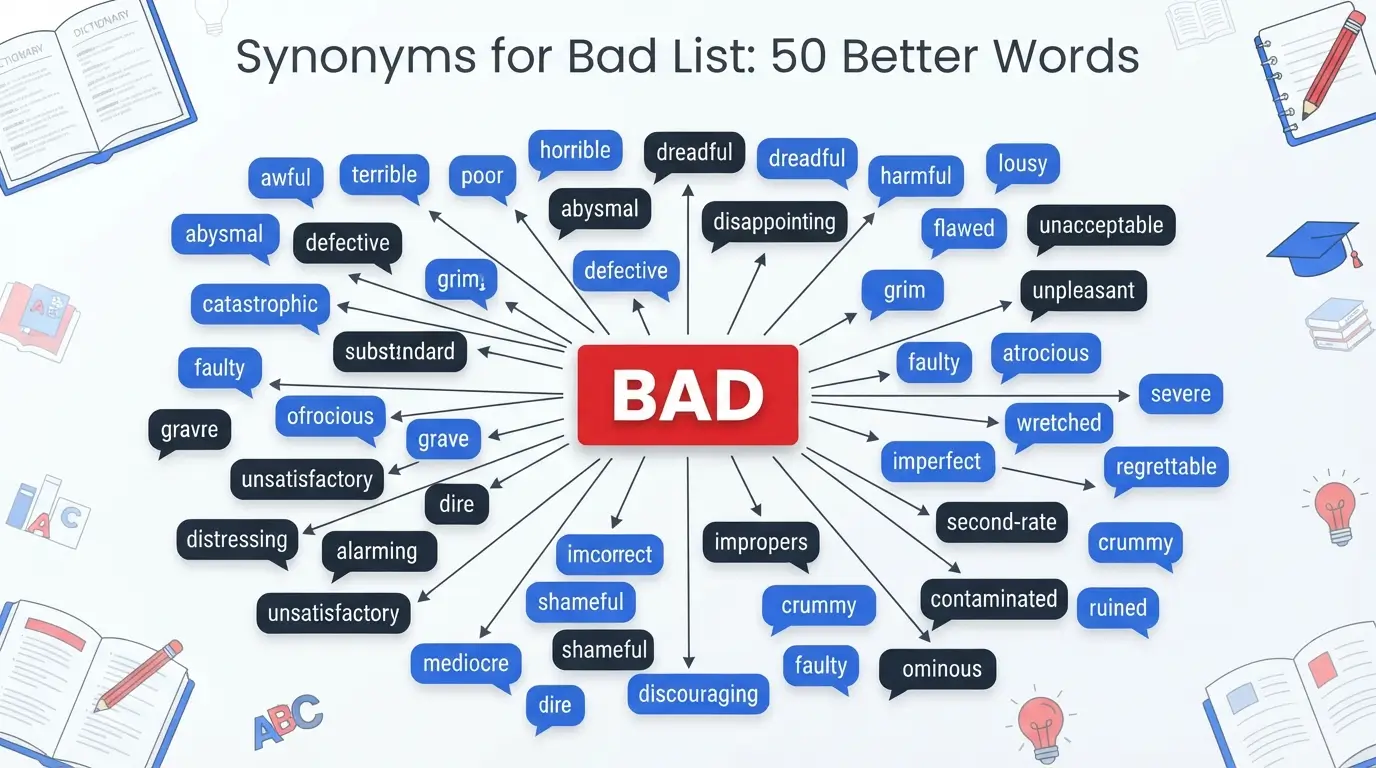
The synonyms for bad list is a collection of words that can replace the word bad in different situations. Instead of using the same word again and again, you can choose a synonym that matches the meaning more clearly. A good synonyms for bad list helps you write better, speak more naturally, and express your ideas with greater accuracy. Whether you need a formal, casual, or descriptive word, this synonyms for bad list will make your English stronger.
Think about writing an essay, a blog post, or even a simple email. You might notice that the word bad appears many times. Repeating the same word makes your writing sound dull. Replacing it with words like poor, awful, terrible, or harmful adds variety and makes your message more interesting.
A student may write, “The weather was bad.” Instead, they could say, “The weather was terrible,” or “The weather was stormy.” A small change makes the sentence clearer and more engaging.
Learning different words for bad is useful for students, bloggers, content writers, and anyone who wants to communicate in clear English. It helps you choose the right word for every situation, whether you are writing an assignment, publishing online, or chatting with friends.
“The difference between the right word and the almost right word is the difference between lightning and a lightning bug.”
“A rich vocabulary gives your ideas greater power and clarity.”
Very Bad Synonyms Formal
Sometimes the word bad is not strong enough, especially in academic, business, or professional writing. Formal English often uses stronger and more precise words to describe serious problems or poor quality.
Words like atrocious, deplorable, abysmal, appalling, and dreadful sound more professional and clearly express how serious something is.
These formal synonyms are common in reports, newspapers, presentations, and official documents.
- Use abysmal for extremely poor quality.
- Choose deplorable for unacceptable situations.
- Pick appalling when something is shocking or upsetting.
Synonyms for Bad List in English
A synonyms for bad list in English includes many words that express different levels of negativity. Some describe poor quality, while others describe harmful actions, unpleasant feelings, or difficult situations.
English offers many choices because every situation is different. Saying a movie is boring is different from saying it is terrible or awful.
Learning these words helps learners sound more natural and avoid repeating the same vocabulary.
- Improve writing by using varied vocabulary.
- Match the synonym to the situation.
- Learn both formal and informal alternatives.
Another Word for Bad Person
A bad person can be described in many ways depending on their behavior. Some words describe someone who is dishonest, while others describe someone who is cruel or selfish.
For example, a villain is an evil character in stories, while a bully hurts or intimidates other people. A criminal breaks the law, and a cheat acts dishonestly.
Choose the word that best matches the person’s actions instead of using the general word bad.
- Villain is common in stories and movies.
- Bully describes someone who mistreats others.
- Criminal refers to someone who breaks the law.
Synonyms for Bad Thing
The phrase bad thing is very general. In English, it is often better to use a more specific word that explains what happened.
Words such as problem, mistake, disaster, danger, and trouble give readers a clearer picture.
Using specific words makes your writing stronger and easier to understand.
- Use problem for everyday issues.
- Use disaster for serious events.
- Use danger when there is a risk of harm.
Synonyms for Very Bad Situation
A very bad situation is something serious, difficult, or dangerous. Different synonyms describe different kinds of situations.
Words like crisis, emergency, catastrophe, disaster, and nightmare are common examples.
Each word has its own meaning, so choosing the right one helps readers understand exactly what happened.
- Crisis often describes urgent problems.
- Catastrophe means a huge disaster.
- Nightmare can describe a very difficult experience.
Another Word for Very Bad
Sometimes you need a stronger word than bad to describe something.
Words such as terrible, awful, horrible, atrocious, and dreadful express stronger negative feelings.
Using stronger vocabulary helps readers understand the seriousness of the situation.
- Use stronger words only when appropriate.
- Match the word to the situation.
- Avoid repeating very bad too often.
Bad Synonym Informal
In everyday conversations, people often replace bad with informal words or slang.
Common examples include lousy, crummy, rotten, junk, and trash. These words are friendly and casual but are not suitable for formal writing.
Informal synonyms are useful when talking with friends or writing conversational content.
- Best for casual conversations.
- Avoid in academic writing.
- Common in spoken English.
Bad Synonym and Antonym
A synonym is a word with a similar meaning, while an antonym has the opposite meaning.
Common synonyms for bad include poor, awful, terrible, harmful, and unpleasant.
Common antonyms include good, excellent, wonderful, great, and outstanding.
Knowing both synonyms and antonyms improves your vocabulary and writing skills.
- Synonyms add variety.
- Antonyms help explain contrasts.
- Both improve communication.
Comparison Table of Related Keywords
| Keyword | Meaning | Usage Type | Common Context |
| Very bad synonyms formal | Strong professional alternatives for “bad” | Formal | Reports, essays, business writing |
| Synonyms for bad list in English | General collection of words replacing “bad” | General | Learning English, writing |
| Another word for bad person | Words describing an immoral or dishonest person | General | Stories, conversations |
| Synonyms for bad thing | Alternatives for negative events or objects | General | Daily conversations, writing |
| Synonyms for very bad situation | Words describing serious problems | Formal & General | News, essays, reports |
| Another word for very bad | Stronger replacements for “very bad” | General | Speaking and writing |
| Bad synonym informal | Casual alternatives for “bad” | Informal | Daily speech, social media |
| Bad synonym and antonym | Similar and opposite words for “bad” | Educational | Vocabulary learning |
1. Poor
Meaning:
Poor means not good in quality or performance.
Examples:
- The restaurant gave us poor service.
- His test score was poor because he missed many questions.
2. Awful
Meaning:
Awful means extremely bad or unpleasant.
Examples:
- The food tasted awful.
- We had an awful day because of the rain.
3. Terrible
Meaning:
Terrible means very bad or very unpleasant.
Examples:
- The traffic was terrible this morning.
- She felt terrible after hearing the news.
4. Horrible
Meaning:
Horrible means very unpleasant or shocking.
Examples:
- The room smelled horrible.
- It was a horrible mistake.
5. Dreadful
Meaning:
Dreadful means extremely bad or disappointing.
Examples:
- We watched a dreadful movie.
- The weather became dreadful in the afternoon.
6. Miserable
Meaning:
Miserable means very unhappy or uncomfortable.
Examples:
- He felt miserable after losing the game.
- The cold weather made everyone miserable.
7. Unpleasant
Meaning:
Unpleasant means not enjoyable or not nice.
Examples:
- We had an unpleasant conversation.
- The smell was unpleasant.
8. Inferior
Meaning:
Inferior means lower in quality than something else.
Examples:
- This product is inferior to the newer model.
- They refused to buy inferior materials.
9. Defective
Meaning:
Defective means having a fault or problem.
Examples:
- The phone was defective when it arrived.
- They returned the defective product.
10. Faulty
Meaning:
Faulty means not working correctly because of a problem.
Examples:
- The machine stopped because it was faulty.
- A faulty cable caused the issue.
11. Harmful
Meaning:
Harmful means causing damage or injury.
Examples:
- Smoking is harmful to your health.
- The chemicals were harmful to plants.
12. Damaging
Meaning:
Damaging means causing harm to someone or something.
Examples:
- The storm had a damaging effect on the town.
- False rumors can be damaging.
13. Dangerous
Meaning:
Dangerous means likely to cause harm.
Examples:
- The road becomes dangerous during heavy rain.
- It is dangerous to swim there alone.
14. Risky
Meaning:
Risky means involving possible danger or loss.
Examples:
- Starting a business can be risky.
- That was a risky decision.
15. Negative
Meaning:
Negative means harmful, unfavorable, or not helpful.
Examples:
- Constant negative comments can hurt confidence.
- The meeting ended on a negative note.
“The words you choose shape the message people remember.”
16. Ineffective
Meaning:
Ineffective means not producing the desired result.
Examples:
- The old medicine was ineffective.
- His plan proved ineffective during the project.
17. Worthless
Meaning:
Worthless means having no value or usefulness.
Examples:
- The broken ticket became worthless.
- He threw away the worthless papers.
18. Useless
Meaning:
Useless means not helpful or unable to serve a purpose.
Examples:
- This tool is useless without batteries.
- The old map became useless after the road changes.
19. Inadequate
Meaning:
Inadequate means not enough or not good enough.
Examples:
- The room had inadequate lighting.
- Their budget was inadequate for the project.
20. Unsatisfactory
Meaning:
Unsatisfactory means not meeting expectations.
Examples:
- The report was unsatisfactory.
- Customer service was unsatisfactory yesterday.
21. Substandard
Meaning:
Substandard means below the expected level of quality.
Examples:
- The company rejected the substandard materials.
- They refused to sell substandard products.
22. Pathetic
Meaning:
Pathetic means very weak, disappointing, or poor.
Examples:
- The team’s performance was pathetic.
- That excuse sounds pathetic.
23. Appalling
Meaning:
Appalling means extremely bad or shocking.
Examples:
- The road conditions were appalling.
- Everyone was shocked by the appalling behavior.
24. Abysmal
Meaning:
Abysmal means extremely poor in quality.
Examples:
- The hotel received abysmal reviews.
- His exam result was abysmal.
25. Atrocious
Meaning:
Atrocious means extremely bad or unacceptable.
Examples:
- The customer service was atrocious.
- They played an atrocious match.
26. Deplorable
Meaning:
Deplorable means very bad and deserving strong criticism.
Examples:
- The living conditions were deplorable.
- Everyone condemned the deplorable actions.
27. Rotten
Meaning:
Rotten means very bad or spoiled.
Examples:
- The fruit had gone rotten.
- We had rotten luck during the trip.
28. Lousy
Meaning:
Lousy means very poor or disappointing.
Examples:
- I had a lousy day at work.
- The movie had a lousy ending.
29. Crummy
Meaning:
Crummy means low in quality or unpleasant.
Examples:
- We stayed in a crummy hotel.
- He felt crummy after catching a cold.
30. Shoddy
Meaning:
Shoddy means poorly made or carelessly done.
Examples:
- The builder used shoddy materials.
- Everyone noticed the shoddy workmanship.
31. Infernal
Meaning:
Infernal means extremely unpleasant or irritating.
Examples:
- The infernal noise kept everyone awake.
- We finally fixed that infernal machine.
32. Disastrous
Meaning:
Disastrous means causing great damage or failure.
Examples:
- The meeting had a disastrous ending.
- Heavy rain caused disastrous flooding.
33. Catastrophic
Meaning:
Catastrophic means causing great destruction or serious harm.
Examples:
- The earthquake had catastrophic effects.
- A catastrophic mistake delayed the project.
34. Dire
Meaning:
Dire means very serious or extremely bad.
Examples:
- The town faced a dire water shortage.
- They were in a dire financial situation.
35. Grim
Meaning:
Grim means serious, sad, or unpleasant.
Examples:
- The doctor shared grim news.
- The future looked grim after the storm.
36. Unacceptable
Meaning:
Unacceptable means not good enough to be approved.
Examples:
- Your behavior was unacceptable.
- The report contained unacceptable mistakes.
37. Disappointing
Meaning:
Disappointing means failing to meet expectations.
Examples:
- The concert was disappointing.
- Their performance was disappointing this season.
38. Unfortunate
Meaning:
Unfortunate means causing sadness or regret.
Examples:
- It was an unfortunate accident.
- We made an unfortunate mistake.
39. Disturbing
Meaning:
Disturbing means causing worry, fear, or discomfort.
Examples:
- The documentary showed disturbing scenes.
- We heard some disturbing news today.
40. Nasty
Meaning:
Nasty means unpleasant, harmful, or unkind.
Examples:
- He made a nasty comment.
- The weather turned nasty by evening.
41. Wicked
Meaning:
Wicked means morally wrong or evil.
Examples:
- The story featured a wicked king.
- Everyone feared the wicked villain.
42. Evil
Meaning:
Evil means deeply immoral or harmful.
Examples:
- The hero defeated the evil magician.
- People stood together against evil actions.
43. Corrupt
Meaning:
Corrupt means dishonest or using power unfairly.
Examples:
- The official was found corrupt.
- A corrupt system hurts everyone.
44. Dishonest
Meaning:
Dishonest means not truthful or trustworthy.
Examples:
- It is dishonest to cheat on a test.
- The customer complained about the dishonest seller.
45. Shameful
Meaning:
Shameful means causing embarrassment because it is wrong.
Examples:
- Their behavior was shameful.
- Leaving trash in the park is shameful.
46. Poorly
Meaning:
Poorly means in a bad or unsatisfactory way.
Examples:
- The report was poorly written.
- The team performed poorly in the final match.
47. Flawed
Meaning:
Flawed means having mistakes or weaknesses.
Examples:
- The plan was flawed from the beginning.
- They found a flawed design during testing.
48. Problematic
Meaning:
Problematic means causing difficulties or creating problems.
Examples:
- The new policy became problematic for small businesses.
- His explanation was problematic and confusing.
49. Unsound
Meaning:
Unsound means not reliable, safe, or well planned.
Examples:
- The engineer discovered an unsound structure.
- That decision was unsound and risky.
50. Inappropriate
Meaning:
Inappropriate means not suitable or proper for a situation.
Examples:
- His joke was inappropriate for the meeting.
- Wearing beach clothes to a wedding is inappropriate.
Conclusion
A strong vocabulary benefits students, bloggers, content writers, professionals, and anyone learning English. Using precise words helps you write better essays, create more interesting blog posts, prepare professional emails, and communicate with greater confidence. It also makes your speaking sound more natural because you can express different shades of meaning instead of relying on one common word.
The best way to remember these synonyms is through regular practice. Try replacing the word bad with a different synonym whenever you write an email, school assignment, social media post, or daily journal entry. Reading books, articles, and newspapers can also help you see how these words are used in real conversations and professional writing.
Over time, these small vocabulary improvements will make a big difference. Your writing will become more descriptive, your conversations will sound more fluent, and your confidence in English will continue to grow. Keep practicing, learn a few new words each week, and soon you’ll have a rich vocabulary that helps you communicate with clarity in every situation.
“The more words you know, the more clearly you can share your ideas.”
“Great writing begins with choosing the right word instead of the easiest one.”
“Every new synonym you learn is another tool for better communication.”

Brother Michael Reyes ek Catholic-inspired author hain jo forgiveness, family protection aur spiritual strength ke topics par likhte hain. Woh apne writings ke zariye logon ko God ke kareeb laane aur unki zindagi mein peace aur clarity dene ki koshish karte hain. Michael ki style simple aur heartfelt hai jo har reader ke dil ko choo leti hai.
👉 Discover his spiritual guidance on Prayerifi.