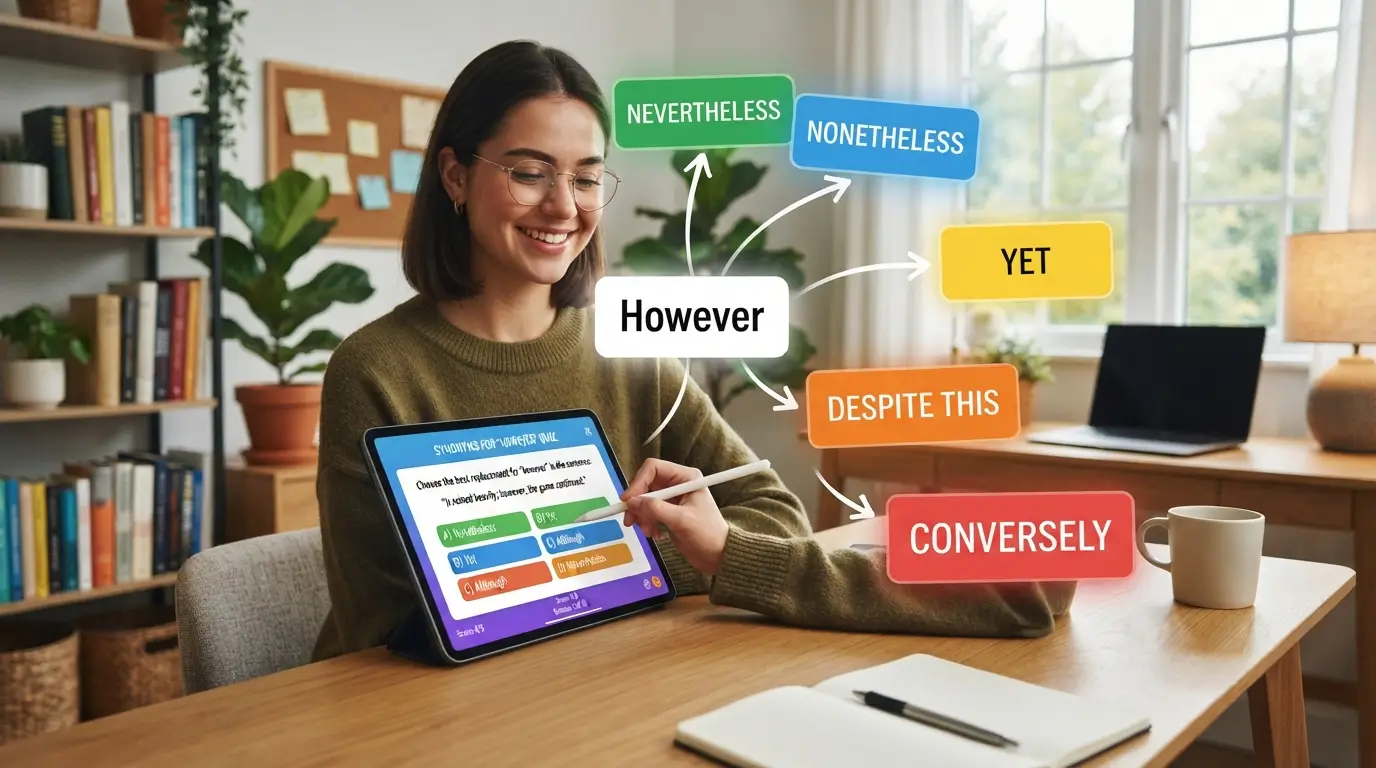
Synonyms for however are words that mean almost the same thing as “however.” A synonyms for however quiz is a fun way to test how many of these words you already know. This kind of quiz helps you learn new words fast and use them the right way in real writing.
Picture this. You are writing an email to your boss. You want to disagree, but “however” feels too plain. You pause. You search for a better word. This happens to almost every writer, student, and blogger at some point. The right word can change the whole tone of a sentence.
“The difference between the almost right word and the right word is really a large matter.” Mark Twain
Here is a simple example. Instead of saying “I like the plan. However, I have one concern,” you can say “I like the plan. That said, I have one concern.” Same meaning. Fresh sound.
In simple English, “however” means “but” or “still.” It shows a change or a contrast between two ideas. That is all it means. Nothing complex.
This word matters for many people. Students need it for essays. Bloggers need it to sound less repetitive. Content writers need it for smooth, natural flow. Daily English users need it for clear texts, emails, and chats.
Learning more synonyms for however makes your writing stronger. It also makes any however quiz much easier to pass. Let’s dive into the full list below.
Why a However Synonyms Quiz Helps You Learn Faster
A quiz format makes learning stick. When you test yourself, your brain works harder to remember the word. This is called active recall, and it works better than just reading a list.
Try this: cover the meaning of each word below and guess it first. Then check your answer. This turns a simple word list into a real however quiz you can use anytime.
As one writing teacher once said, “You don’t have to be a great writer to notice a weak word.” Noticing weak words is the first step to fixing them.
Comparison Table: Common “However” Alternatives
| Word/Phrase | Meaning | Usage Type | Context |
| Nevertheless | In spite of that | Formal | Essays, reports |
| Nonetheless | Even so | Formal | Business writing |
| Still | But even so | Casual | Daily conversation |
| Yet | But | Casual/Formal | Any writing |
| That said | Keeping this in mind | Semi-formal | Blogs, speech |
| On the other hand | Showing contrast | Neutral | Comparisons |
| Regardless | No matter what | Formal | Workplace |
| Even so | Despite this | Casual | Daily talk |
| Notwithstanding | Despite that | Very formal | Legal, academic |
| Anyway | Moving on despite this | Casual | Chats, texts |
This table shows that not every word fits every situation. A formal report needs nevertheless, but a text to a friend works better with still or anyway.
50 Synonyms for However
1. Nevertheless
Meaning: It means “even though that happened, this is still true.” Examples:
- The rain was heavy; nevertheless, the game went on.
- She felt tired; nevertheless, she finished the run.
2. Nonetheless
Meaning: It shows a fact stays true even after a problem. Examples:
- The plan had risks. Nonetheless, we moved forward.
- He was new. Nonetheless, he did a great job.
3. Still
Meaning: A short word that shows something has not changed. Examples:
- I said no. Still, he kept asking.
- The food was cold. Still, we enjoyed it.
4. Yet
Meaning: It connects two ideas that seem to clash. Examples:
- She is quiet, yet she leads the whole team.
- The house is small, yet it feels cozy.
5. But
Meaning: The simplest word to show a change in thought. Examples:
- I wanted pizza, but we had tacos instead.
- He tried hard, but the door stayed locked.
6. Though
Meaning: It softly shows a contrast between two facts. Examples:
- It was cold, though the sun was bright.
- She smiled, though her day was rough.
7. Although
Meaning: A formal word to join two opposite ideas. Examples:
- Although it rained, we went hiking.
- Although he was tired, he studied late.
8. Even So
Meaning: It means “despite what was just said.” Examples:
- The test was hard. Even so, she passed.
- Traffic was bad. Even so, we arrived on time.
9. On the Other Hand
Meaning: It shows a second, different point of view. Examples:
- I love the beach. On the other hand, my sister loves the mountains.
- The car is cheap. On the other hand, it uses more fuel.
10. In Contrast
Meaning: It points out a clear difference between two things. Examples:
- Summers here are hot. In contrast, winters are freezing.
- His first book was slow. In contrast, this one is fast-paced.
11. Conversely
Meaning: A formal word meaning “in the opposite way.” Examples:
- Sales rose in June. Conversely, they dropped in July.
- He speaks softly. Conversely, his brother shouts a lot.
12. That Said
Meaning: It means “keeping the last point in mind.” Examples:
- The hotel was noisy. That said, the staff were kind.
- The movie was long. That said, I still enjoyed it.
13. Having Said That
Meaning: A longer way to say “but, thinking about it more.” Examples:
- The job pays well. Having said that, the hours are tough.
- She is strict. Having said that, she is very fair.
14. Notwithstanding
Meaning: A formal word meaning “despite” or “in spite of.” Examples:
- The storm, notwithstanding, did not stop the flight.
- His doubts notwithstanding, he signed the deal.
15. Be That As It May
Meaning: It means “even if that is true, here is another point.” Examples:
- You may be right. Be that as it may, we must follow the rule.
- He is talented. Be that as it may, he needs more practice.
16. All the Same
Meaning: It shows a result does not change despite a fact. Examples:
- It’s a small gift. All the same, thank you.
- The road is bumpy. All the same, the view is worth it.
17. At the Same Time
Meaning: It links two true but different ideas. Examples:
- I want to save money. At the same time, I want to travel.
- He is kind. At the same time, he is firm.
18. In Spite of That
Meaning: It means “despite the problem just mentioned.” Examples:
- The Wi-Fi was slow. In spite of that, we finished the call.
- She was scared. In spite of that, she spoke on stage.
19. Despite That
Meaning: A short way to say “even with that problem.” Examples:
- He lost the match. Despite that, he stayed positive.
- The price rose. Despite that, sales stayed strong.
20. Regardless
Meaning: It means “no matter what happens.” Examples:
- Regardless of the weather, the show will go on.
- She keeps trying, regardless of the setbacks.
21. Whatever the Case
Meaning: It means “no matter what the situation is.” Examples:
- Whatever the case, we need a backup plan.
- Whatever the case, be honest with your team.
22. On the Flip Side
Meaning: A casual way to show the other side of a point. Examples:
- The rent is low. On the flip side, the area is noisy.
- He’s strict. On the flip side, he’s very fair.
23. Alternatively
Meaning: It offers another option or a different idea. Examples:
- We can drive. Alternatively, we can take the train.
- You can email me. Alternatively, call my office.
24. Contrarily
Meaning: It means “in an opposite way to what was said.” Examples:
- He seems shy. Contrarily, he loves public speaking.
- Sales dropped in stores. Contrarily, online sales grew.
25. In Any Case
Meaning: It shows a point that stays true no matter what. Examples:
- In any case, we should double-check the numbers.
- In any case, thank you for trying.
26. Anyhow
Meaning: A casual word to move past a small problem. Examples:
- The plan changed a bit. Anyhow, let’s start.
- It was a long day. Anyhow, we made it home safe.
27. Anyway
Meaning: It shows you are moving forward despite something. Examples:
- It’s late, but let’s finish this anyway.
- The road was closed. Anyway, we found another route.
28. Just the Same
Meaning: It means “the outcome does not change either way.” Examples:
- It’s a busy week. Just the same, call me anytime.
- He’s young. Just the same, he leads the group well.
29. For All That
Meaning: It means “despite everything that was said.” Examples:
- For all that, she never gave up on her dream.
- For all that, the team stayed loyal to their coach.
30. In Any Event
Meaning: A formal phrase meaning “whatever happens next.” Examples:
- In any event, we will send the report by Friday.
- In any event, please keep the receipts.
31. Even Though
Meaning: It joins a fact and a surprising result together. Examples:
- Even though it was late, she called back right away.
- Even though he was busy, he helped his neighbor.
32. Admittedly
Meaning: It means “I accept this fact is true.” Examples:
- Admittedly, the design needs some work.
- Admittedly, I was wrong about the schedule.
33. Granted
Meaning: It shows you accept a point before adding another. Examples:
- Granted, the trip was costly, but it was worth it.
- Granted, he’s new, but he learns fast.
34. With That Said
Meaning: It means “keeping the last idea in mind, but.” Examples:
- With that said, let’s move to the next topic.
- With that said, I still support the plan.
35. Howbeit
Meaning: An old-style word meaning “however” or “still.” Examples:
- Howbeit, the truth came out in the end.
- Howbeit, they remained close friends for years.
36. Withal
Meaning: An old word meaning “in addition” or “even so.” Examples:
- He was poor, withal, he was always generous.
- The road was long, withal, they enjoyed the trip.
37. Contrariwise
Meaning: A playful word meaning “in the opposite way.” Examples:
- Contrariwise, the smaller team won the final.
- He expected rain. Contrariwise, the sun came out.
38. But Then
Meaning: It adds a sudden change of thought. Examples:
- I almost quit. But then, I remembered my goal.
- She was upset. But then, she saw the surprise party.
39. Then Again
Meaning: It shows you are reconsidering a point. Examples:
- I could walk there. Then again, it might rain.
- He seems confident. Then again, he gets nervous on stage.
40. On the Contrary
Meaning: It strongly shows the opposite is true. Examples:
- You think it failed? On the contrary, it was a big success.
- On the contrary, the new rule made things easier.
41. Despite This
Meaning: It means “even with this fact in place.” Examples:
- The market fell. Despite this, our sales grew.
- Despite this delay, the project stayed on budget.
42. Notwithstanding This
Meaning: A formal way to say “even with this point.” Examples:
- Notwithstanding this, the board approved the plan.
- Notwithstanding this issue, the launch went smoothly.
43. All Things Considered
Meaning: It means “after thinking about everything.” Examples:
- All things considered, it was a good year.
- All things considered, the team performed well.
44. Still and All
Meaning: A folksy way to say “even so.” Examples:
- Still and all, we had a great time.
- Still and all, he never stopped smiling.
45. Even Still
Meaning: It stresses that something stays true anyway. Examples:
- The price went up. Even still, people kept buying it.
- She was warned. Even still, she took the risk.
46. For That Matter
Meaning: It adds a related point that fits the topic. Examples:
- I don’t like coffee. For that matter, I avoid tea too.
- He’s not free today. For that matter, he’s busy all week.
47. In Either Case
Meaning: It means “whichever choice is made.” Examples:
- In either case, we need to inform the client.
- In either case, the result should be the same.
48. Yet Still
Meaning: It doubles the sense of continued contrast. Examples:
- He apologized, yet still, she felt hurt.
- The car was old, yet still, it ran perfectly.
49. Having Said This
Meaning: Another way to say “keeping this point in mind.” Examples:
- Having said this, we should review the budget again.
- Having said this, I trust your final decision.
50. Regardless of That
Meaning: It shows a choice stays firm despite a problem. Examples:
- Regardless of that, we launched the product on time.
- Regardless of that, she kept training every morning.
Conclusion
Learning synonyms for however does more than fill your vocabulary. It sharpens your writing, improves your blogging, boosts your speaking, and makes your daily communication clearer. When you swap the same tired word for a fresh one, readers stay interested and your ideas land better.
Try using three new words from this list in your next email. Pick one for an essay. Slip another into a daily conversation with a friend or coworker. Small changes like this build strong writing habits over time.
“Language is the road map of a culture. It tells you where its people come from and where they are going.” Rita Mae Brown
Keep this list close. Turn back to it whenever “however” feels too plain. Practice a little each day, and soon these words will come to you naturally, without any effort.
“To limit yourself to one word is to limit your thoughts.” Anonymous
“The right word may be effective, but no word was ever as effective as a rightly timed pause.” Mark Twain

Emma is a language enthusiast and content writer at Prayerifi.com. She specializes in synonyms, word meanings, vocabulary development, and English language comparisons. Her goal is to create clear, engaging, and easy-to-understand content that helps readers improve their language skills and expand their vocabulary.